
Dictators and Dealmakers:
Trump, Bolsonaro and Lula managing the landscape of international trade and shaky democratic norms

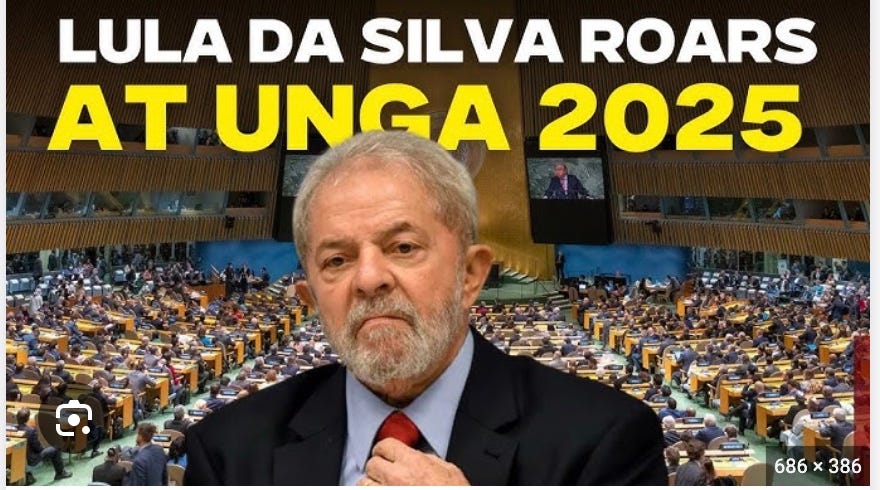
Brazilian President Luiz Inacio Lula da Silva, President of Brazil, at the United Nations General Assembly, September 22, 2025
After January 6, 2020, when Americans assaulted the seat of the US government in an effort to overthrow the legitimate government of the United States, egged on by President Trump himself both before and during the event, Jair Bolsonaro, the then-president of Brazil–yes, Brazil–was so inspired by the uprising that he decided to stage a similar insurrection on the federal capital of Brazil just a few months later. The outcomes of the two insurrections were dramatically different, but the impact of the two events reverberates still.
As we now know, Mr. Trump aimed to overturn the US election by delegitimizing the vote count and, if necessary, removing Trump’s own vice president, Mike Pence, to do so.
Self-perceived warrior that he is, former President Trump set the torches aflame with a passionate speech and call to arms on the White House Lawn on the morning of January 6, 2021. Then he waved his followers to go forward and claim the day, and that he was “with them.”
But Trump wasn’t actually with them. He slipped out of the melee to watch the battles from inside the White House. He watched the riot on television for hours. Multiple accounts and testimony confirm that he was in the White House Dining Room and the Oval Office area while the violence unfolded at the U.S. Capitol a mile away.
President Trump also had a cozy relationship with a former president of Brazil, Jair Bolsonaro. A Brazilian politician and former military officer who had served as the 38th president of Brazil from 2019 to 2023, Bolsonaro admired Trump’s bombastic and “dealmaker” style. Trump was flattered. He admired Bolsonaro’s heavy handedness in moving Brazil once again towards a dictatorship.
On January 8, 2023, Bolsonaro fomented an armed criminal conspiracy to overturn Brazil’s 2022 presidential election results, which had named Lula Inacio da Silva, a socialist and former coal miner, the winner. Lula had already assumed office in Brasilia, the country’s capital.
Much like the insurrection in the United States, the Bolsonaro plot included violence against state institutions and damage to public property during riots in Brasília.
Thousands of Bolsonaro supporters stormed and vandalized the National Congress, the Supreme Federal Court, and the presidential palace in Brasília. The attack was the culmination of months of election denialism, disinformation, and political polarization led by Bolsonaro and his allies.
Bolsonaro and his allies had sowed distrust in Brazil’s electoral system, particularly its electronic voting machines, for years. Sound familiar? Bolsonaro, like Trump, made repeated, baseless claims that the system was susceptible to fraud, laying the groundwork for his followers to reject any election loss. When the election results were announced, and he had actually lost, Bolsonaro refused to concede. He then left Brazil and traveled to Florida just before Lula’s inauguration. Wow.
Following the election, thousands of Bolsonaro supporters gathered outside military bases across the country and in Brasília, calling on the armed forces to intervene and overturn the election results.
In the same way that attacks on the U.S. Capitol in January of 2021 developed, the attacks on Brazil’s seat of government were organized through messaging apps and social media, with organizers encouraging supporters to travel to Brasília. Investigations revealed plans for a coup, including discussions of assassinating President-elect Lula and a Supreme Court justice.
Despite clear signs that Bolsonaro supporters intended to incite violence, security forces in Brazil’s capital found themselves flatfooted and inadequately prepared.
Looking back, the Bolsonaro-inspired insurrection was a copy of January 6. That it all went sideways made Donald Trump really unhappy.
On The day of the attack, January 8, 2023, thousands of pro-Bolsonaro protesters marched from their camps near the army headquarters to the Three Powers Plaza in Brasilia. Rioters overwhelmed the small contingent of police at the plaza and invaded the three key government buildings—the National Congress, Supreme Federal Court, and presidential palace—which were largely empty at the time. The mob vandalized the buildings, destroyed historical artifacts, stole items, and left behind widespread destruction.
Yes, this is creepily familiar. But wait: the ending is different.
After several hours, security forces regained control of the buildings. President Lula condemned the acts as barbaric and ordered federal security forces to intervene. The Supreme Court swiftly suspended the Federal District governor, who was a Bolsonaro ally, and ordered the protest camps to be dismantled.
Over 2,000 individuals were investigated, with many arrested and receiving lengthy prison sentences for crimes like attempted coup, vandalism, and conspiracy.
Trump was initially flattered by Bolsonaro’s imitation of the January 6 insurrection in the United States, but he is not one to be loyal to a “loser,” which Bolsonaro turned out to be. Bolsonaro was arrested. His trial began on 2 September, 2025; on 11 September, 2025, a panel of five Supreme Court justices found him guilty by a 4–1 vote. He was sentenced to 27 years and 3 months in prison. The verdict made him the first former president in Brazil’s history to be convicted for attacking democracy.
Trump didn’t defend Bolsonaro. Instead, Lula and and a handful of wealthy Brazilians reached out to Trump with a different and more mutually beneficial deal: in exchange for sending Brazilian cattle and other goods to the U.S., American tariffs on Brazil would be significantly reduced.
These negotiations not only helped Trump move on from his tainted bromance with Bolsonaro, but they also helped Trump to pivot to his art of the deal persona.
On Wednesday, September 24, 2025, at the UN nations general assembly in New York, Lula told reporters that he hoped he and US president Donald Trump would mend the relationship between the two countries.
“We are the two largest economies and the two largest countries in the continent,” he said. “There is no reason for Brazil and the United States to be in conflict. I made a point of telling President Trump that we have a lot to talk about,” Lula continued. “Many interests of both countries are at stake [and] There’s a lot to discuss about the need for us to ensure peace on planet earth. I’m convinced that some of president Trump‘s decisions were driven by the [poor] quality of information that he had regarding Brazil.
“When he has the right information, I think he can easily change his position. Just as Brazil can change its position.”
Who’s the great negotiator now? Lula or Trump? Lula is willing to aggressively trade with American beef producers in exchange for a lowering of U.S. tariffs, but that’s just a start. Brazil has enormous natural resources. Can they/we use them judiciously and for the long term?
I guess those are problems to solve on another – hotter – day.
Alexandre de Moraes - Wikipedia
Wikipedia https://en.wikipedia.org/wiki/Alexandre_de_Moraes
https://www.reuters.com/video/watch/idRW788025092025RP1/
Lula hopes to mend Brazil – US ties in meeting with Trump.
Trump’s tariffs over treatment of Bolsonaro push Brazil closer to China
To consider next: the decades of authoritarianism in Brazil, the arrests, torture and murder, and the reckoning. The publication of Brasil Nunca Mais and the film about the dictatorship, "I'm Still Here."